
Is Eating Red Meat and Cheese as Deadly as Smoking?
Is Eating Red Meat and Cheese as Deadly as Smoking?
- Manage your Account
- Start Here
- Guides
- Nutrition
- Training
- Lifestyle & Motivation
- Webinars
- Research Reviews
- Resources
What you’re about to get into?
2100 words, 25-minute read.
Key Points
- Dietary protein isn’t as harmful as smoking.
- Consuming too many calories from protein and processed meats without enough exercise is an issue.
- IGF-1 plays a role in the ageing process and mortality.
- IGF-1 is an anabolic agent that causes cell growth, including cancerous cells.
- High-protein diets can be effective in improving key markers of cardiovascular risk in people with diabetes and should be considered part of an effective nutritional strategy for managing diabetes.
- Most shock stories on health, diet and fitness are written by journalists with little to no knowledge (or experience) of human physiology, nutrition or exercise physiology.
Is eating red meat and cheese really as bad as smoking?
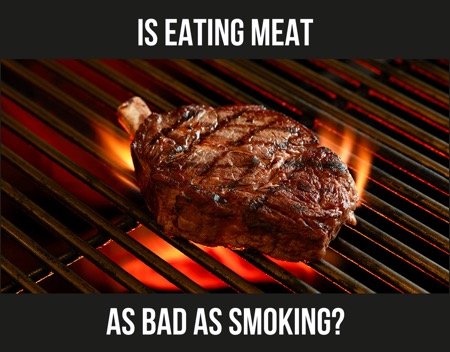
You may or may not have heard the recent study that made the headlines, with the news that ““Eating large amounts of meat, cheese may be as deadly as smoking.”
That’s a pretty serious claim that would give many bodybuilders, weightlifters and fitness addicts the meat sweats.
Linking popular foods like meat and cheese to smoking is pure and utter sensationalism. The sole aim of a title like this is to grab your attention and encourage you to buy a newspaper or view the news.
They need to make their money and get views from somewhere.
The study in question is genuine, but only if you disregard the ridiculous claim that eating meat is as harmful as smoking.
Let’s take a quick look at the study goals, design, and general findings.
Epidemiological and rodent intervention studies set out to assess the role of dietary protein intake on IGF-1 levels, cancer risk and overall mortality in the 65 and younger (but not older) population.
You can read more about the study here.
What is IGF-1?
IGF-1 is a primary mediator of the effects of growth hormone (GH). Growth hormone is made in the anterior pituitary gland, is released into the bloodstream, and then stimulates the liver to produce IGF-1.
Why research it?
It has been suggested that IGF1 levels influence physiological changes related to ageing and development of age-related diseases such as cancer and cardiovascular disease (CVD) 1,2,3
Two Studies Were Involved.
An epidemiological and mouse study.
An epidemiological study observes a specific population for a period of time and tries to determine a particular outcome in relation to set factors.
In this case, the effect of long-term dietary protein intake on IGF-1, cancer risk, and mortality.
A mouse study to support the findings of the epidemiological study. Humans and mice share many common genetic features and by examining the physiology, anatomy, and metabolism of a mouse, scientists can gain a valuable insight into how humans function.4
Needless to say, the findings from both types of research cannot be used to state “X causes Y”. On the other hand, any time cancer or tumour growth is mentioned in the mouse study, it solely applies to the mice in question and cannot be applied to the human study findings.
Observational studies like this are useful incentives for further research.
The Human Epidemiological Study
Pre-existing survey data was taken from The 3rd National Health and Nutrition Examination Survey (NHANES).
This particular survey research is conducted by the National Centre for Health Statistics (NCHS) to assess the health and nutritional status of adults and children in the United States, and to track changes over time.
The 3rd NHANES survey assessed 6381 adults over the age of 50 years old.
The baseline protein intake data showed that, on average, protein made up 16% of the cohort’s caloric intake and 69% was derived from animal-based protein (meat, fish, eggs etc.) This data was used to subdivide the population size into three distinct sample groups.
- High Protein intakes >20%
- Moderate Protein – Between 10-20%
- Low Protein intakes <10%
The data for these three groups of people were observed over the next 18 years to ascertain if disease or mortality rate differed between those consuming different amounts of protein.
What did they find?
- A positive link between moderate and high protein intakes and diabetes-related mortality, compared to the lowest protein intake.
- No relation between higher protein intake with all-cause mortality, cancer-related mortality, or cardiovascular mortality overall.
- A small increase in risk was seen when looking only at people between the ages of 50-65 years old.
- This risk was reversed for people above the age of 65 years old, where dietary protein seemed to have a protective effect against all forms of mortality (excluding diabetes-related).
In conjunction with these findings, IGF-1 levels were investigated from a smaller population size of 2,253 individuals. They found that,
- IGF-1 levels increased in correlation to meat intake, predicted overall mortality seen in the 50-65 cohort as well as the 66+ cohort.
- The protective effects of protein intake in the elderly (66+) persisted when IGF-1 levels were lower.
- Higher levels of IGF-1 were not linked to protective effects, although they weren’t correlated with increased mortality either.
- This part of the study was only conducted in people over the age of 50 years old only.
- Animal and/or plant protein intakes were accounted for.
- Once protein intake had been assessed, other dietary variables like general calorie and macronutrient intakes were accounted for.
- Additional controls included sex, age, ethnicity, education, disease status, smoking status, dietary changes, and previously attempted weight loss.
Given all the epidemiological evidence additional research was conducted using mice to confirm causation.
The Rodent Study
- A population of mice was implanted. Mice were fed a high (18%) or low (4-7%) protein diet for 7 days prior to being implanted with B16 melanoma cells, a murine tumour cell line used for research as a model for human skin cancers.
- It was observed that the majority of mice in both the high (100%) and low (90%) protein groups bore tumours.
- However, the size of the tumours in the low protein group was 78% smaller relative to the size in the high protein group.
- The high protein mouse group had higher levels of IGF-1 whereas there were higher levels of IGF-1 inhibitor protein (IGFBP-1) in the low protein group.
- The study was repeated in mice deficient in growth hormone(GH), to replicate the lower GH output of older adults.
- Tumour growth was lower in the high-protein group (10-20% of what was seen previously in normal mice given the same dose of protein).
- The study was replicated using breast cancer cells rather than B16 melanoma. The results were similar.
- The study was also repeated to compare the effects of higher quality animal protein (casein) to plant (soy) protein. This did not change the results much, as serum IGF parameters were similar.
- It was noted that the expected negative effects of high protein intakes turned positive in older mice.
So, what do the studies tell us?
- IGF-1 plays a role in the ageing process and mortality.
- IGF-1 is an anabolic agent that causes cell growth, including cancerous cells.
- IGF-1 levels can be influenced by overall protein intake
- Higher protein means more IGF-1.
- Higher protein intakes may be protective in individuals over 65 years old (unless they had diabetes)
- Protein is not as harmful as smoking.
Take These Findings with A Pinch of Salt.

There are many questions that this kind of research doesn’t address, and another reason why they cannot prove causation.
- What about the noted health benefits of exercise? Can exercise have a protective effect? What about those who strength train and have increased protein demands?
- What about the source of protein? The study only observed animal vs plant sources and didn’t address the nutritional quality between minimally processed fresh cuts of meat compared to highly processed meats like salami, and fast food burger patties.
- What about people younger than 50 years old? Do the findings still apply? Are they at more or less risk?
- What about different sources of fruits and vegetables? Surely, if rotated they would have provided a broader spectrum of health-promoting nutrients? These were not counted, just carbs and fats.
- What did the low protein group eat to compensate? Could the macronutrient used to replace protein have a protective effect or not.
- What about levels of stress, and sleep? These are very important lifestyle factors that play a role in health.
Does this mean protein is bad for people with diabetes?
NO.
First of all, the number of people with diabetes involved in the study was extremely small and would have had an inflated effect on their findings.
The authors even highlight this:
“We underline that our hazard ratios and confidence intervals may be inflated due to our sample size and the extremely low incidence of diabetes mortality in the low protein group. Overall, there were only 21 diabetes deaths among persons without diabetes at baseline, only 1 of which was from the low protein group”
Consequently, we need to look at the bigger picture and overall body of evidence outside one study before jumping to conclusions.
First of all, let’s look at the facts:
- Higher protein intakes increase the workload on the kidneys.
- People with diabetes are at increased risk of kidney disease (nephropathy) especially if their diabetes is poorly managed.
Is it wise for people living with diabetes to consume more protein?
In poorly controlled individuals with signs of kidney trouble, maybe not.
On the contrary, what about the person with well-controlled diabetes who exercises regularly?
Protein intake in T1D
There is substantial evidence to suggest high protein diets do not harm a set of healthy kidneys in people without diabetes.
Although people living with T1D may have healthy kidney function, they are at increased risk of kidney complications, which may caution against high intakes of protein.
If the individual strength trains, this may permit a higher protein intake.
Research investigating protein intake in people living with T1D with healthy kidney function is limited and definitely warrants further research.
Protein intake in T2D
The Systematic review and meta-analysis of different dietary approaches to the management of type 2 diabetes provides strong evidence to support the consumption of protein in people with diabetes.
The review suggests that a high-protein diet is effective in improving various markers of cardiovascular risk in people with diabetes and should be considered in the overall strategy of diabetes management.
In both populations, protein has been proven to improve glycemic control and help control appetite, both of which are important in preventing obesity and diabetes-related complications.
Take Home
Dietary protein has been linked to mortality in these two studies. However, the research is limited to people over 50 years old, doesn’t account for exercise and other important factors such as the source of meat (processed vs non-processed).
The studies support IGF-1’s role as an anabolic agent responsible for cell growth, no matter the type of cell.
For those who exercise regularly, increased levels of IGF-1 will assist with muscle growth and recovery. On the other hand, increased levels of IGF-1 in sedentary overweight/obese individuals consuming a poor diet may be problematic.
As a journalist, with very limited knowledge/experience in evidence-based nutrition and health data, it’s easy to take things out of context and make misleading sensationalist claims.
A more accurate title for the findings of this study would have been “People between the ages of 50-65 years of age who are overweight, and have a history of poor diet and lifestyle habits are at increased risk of cancer.”
Oh and as for ‘cheese’ – given that it’s a major source of dietary fat with limited protein I’m still confused how it got thrown into the headline. This would be a different article altogether.
Written by Phil Graham
Founder of Diabetic Muscle and Fitness
Sports Nutritionist, Strength Coach, and Fitness Educator
Type 1 Diabetic for 12 years
When it comes to Nutrition & Health, the media ONLY report on topics that can be sensationalized, and with no apparent concern about the accuracy of such pieces.
The details and complexities of interpreting research findings can be time-consuming and hard, but very worthwhile.
Don’t fall for click bait health and nutrition headlines.
References
- Janssen JA & Lamberts SW. IGF-I and longevity. Hormone Research 62 2004104–109.
- Renehan AG, Zwahlen M, Minder C, O’Dwyer ST, Shalet SM & Egger M. Insulin-like growth factor (IGF)-I, IGF binding protein-3, and cancer risk: systematic review and meta-regression analysis. Lancet 2004 ;363:1346–1353.
- Kaplan RC, Strickler HD, Rohan TE, Muzumdar R & Brown DL. Insulin-like growth factors and coronary heart disease. Cardiology in Review 2005 ;13:35–39
- Why use the mouse in research? www.yourgenome.org/facts/why-use-the-mouse-in-research