
Whey Protein and Diabetes – Everything You Need To Know
Whey Protein and Diabetes – Everything You Need To Know
- Manage your Account
- Start Here
- Guides
- Nutrition
- Training
- Lifestyle & Motivation
- Webinars
- Research Reviews
- Resources
What you’re about to get into?
- 4800 words, 35-45 minute read.
Key Points
- Once all the bases are covered, you may get a small benefit of supplemental Whey Protein if you struggle to hit 1.5-2.0g/kg (0.7-1.0g/lb) of quality protein from real foods.
- Before considering Whey protein, ensure you have covered all the bases of the Diabetic Muscle and Fitness NUTRITION PYRAMID and TRAINING PYRAMID.
- Remember Supplements are the least important component. Focus on REAL FOOD first to hit your protein requirements.
- Real food provides a host of nutrients and nutritional factors that benefit your overall health.
- When nutrient timing is important such as training twice a day, whey protein has some nutritional properties that can help with oxidative stress, non-alcoholic fatty liver disease, and possibly body composition.
- Whey protein requires more insulin to be metabolized, due to the high Leucine content – You need to know how to manage this for both type 1 and type 2 diabetes.
- Don’t be tricked by marketing, know the difference between Whey Concentrate, Isolate and Hydrolysate. Find out how to choose wisely and save your money.
Does whey protein live up to the hype for people with diabetes?
Can I take whey protein safely if I have Diabetes? What about my kidneys?
Am I wasting my money on another marketing scam?
My healthcare professional says I do not need protein supplements, do they really know, or are they playing it safe?
All my gym buddies take whey and swear by it, but they don’t have diabetes, will it work for me?
These are questions I hear all the time in my clinical Diabetes practice, mainly by men and women who are starting the gym and want to build a great physique. They want to maximise their gym efforts by supplementing with whey protein, but they are concerned with safety, the effects on blood glucose level, and their finances. Sound familiar?
There are some amazing articles online that have every last detail of whey protein.
But I am guessing you do not want every last detail, right?
If you want the most potent information, in an easy to understand format, that is specific to diabetes? This article is perfect for you.
Not only that, it details the best practical strategies, straight from the pioneering Diabetic Muscle and Fitness Community. These strategies are guaranteed to put you in control of your blood glucose levels and get the most out of whey protein.
Oh, one more thing, I guess you want a diabetes-specific guide for how to choose the right whey? Don’t worry that is covered too.
Ready? Let’s go.
Before we get into the specifics, let’s get some perspective.
Where do you think whey protein fits into the diabetes pyramid of muscle building?
What about other supplements like Creatine, L-Leucine, Magnesium, Fish oil?
What other nutrition factors like calories, carbs, fats and the timing of your meals?
If you were to believe the marketing hype, you would think protein supplements are the essential ingredients for building muscle and getting in great shape. This couldn’t be further from the truth, especially if you have diabetes.
Let’s get real shall we?
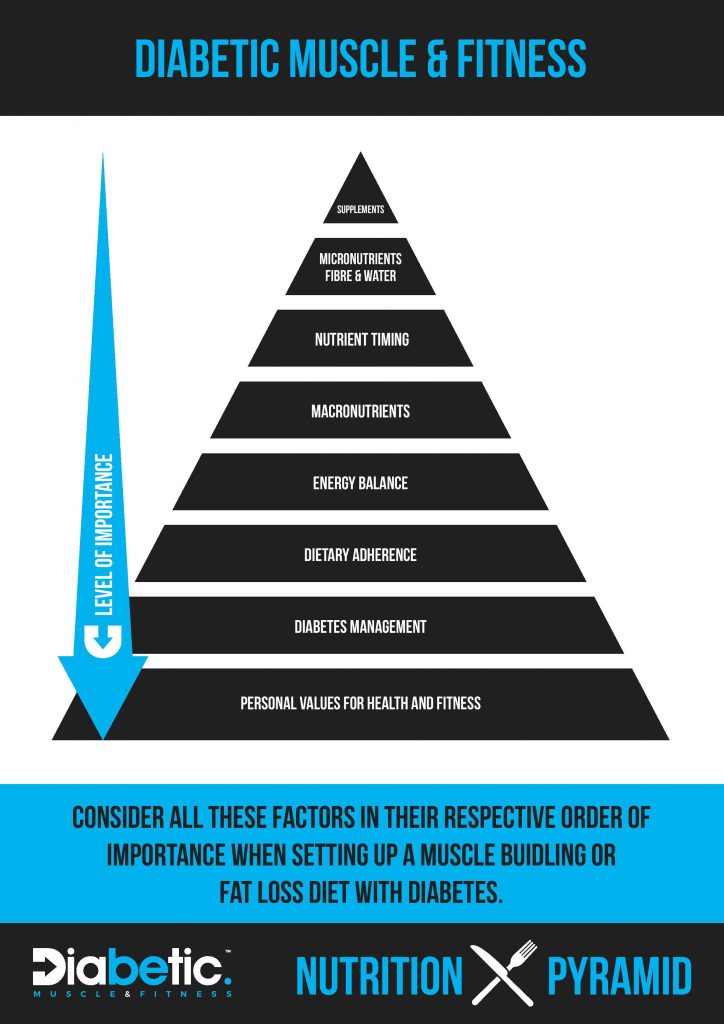
The Diabetic Muscle and Fitness Nutrition Pyramid lays out all the key diet-related factors in order of their importance. Let’s review each of them and get context on where whey protein lies and how it can be incorporated into a successful muscle building regime for men and women with diabetes.
Personal Value For Health and Fitness
Your personal values for health and fitness are the foundation for your results. You need to be driven to eat in a certain way. That means respecting key principles, all of which are outlined in order of importance in the pyramid above.
The same goes for your training and lifestyle. If you don’t value getting in shape and improving your health you’ll not put the effort into your training and living correctly to get the results you need.
If you can envision a goal, become emotionally attached to it, and identify exactly what you need to do, you’ll have no problem being consistent with your daily actions.
Over time, these actions mount up and will get the results you desire.
There are many people who take a notion of getting in shape, buy a tub of whey protein and expect miracles to happen overnight.
Many of you who have tried this, will know too well, that a great body doesn’t come that easy. It takes time.
See, if your head and goals aren’t in the right place it doesn’t matter what protein you buy. You won’t get results.
Diabetes Management (Blood Glucose Control)
The research is crystal clear. If you have a high HbA1c, or if you have consistent high glucose levels before or during training, you will cripple your muscle building efforts (1)
Bottom line – Get your diabetes well controlled before considering whey protein. Period.
Dietary Adherence
If your nutrition doesn’t suit your personal needs you won’t stick to it, whether it includes whey protein or not. Simple. Make sure to check out the execution plans on how to build a diet that’s enjoyable, sustainable and gets results.
Energy Balance
Depending on whether your goal is fat loss or mass gain, you need to be consistently consuming the correct number of calories.
If leaning out is your goal, you need a daily 10-20% calorie deficit.
Whereas if you are trying to gain mass, you need a daily 5-10% calorie surplus.
“What about the effect of carbs, protein and fat?”
Yes, they have a big impact, but don’t be misled, energy intake is king, no matter what the gurus say. You just have to review the metabolic ward studies (2) by Kevin Hall to confirm how important calories are with respect to fat gain and fat loss.
How many calories do you need to hit consistently? Go and get your personalized prescription from the Diabetes Muscle and Fitness calculator (check the resources section).
Macronutrients
When it comes to macronutrients, the research demonstrates time and again that, ‘Consuming an optimal level of protein for your phase of training is the force multiplier for physique development.
Most of the marketed benefits of whey protein are due to one simple thing: achieving an optimal level of protein for your phase of training.
Those benefits include:
- Improved fat loss
- Increase in lean muscle mass
- Improved power output
- Reduced Grehlin (hunger hormone)
Be sure to check you are hitting the optimal level of protein intake. The well researched Diabetic Muscle and Fitness Guide recommendations are:
- Leaning or dieting: 1.7 – 2.0g/kg (0.8 – 0.9g/lb) of lean body mass
- Bulking or gaining: 1.4 – 1.7g/kg (0.6-0.8g/lb) of lean body mass
The Diabetes Muscle and Fitness calculator in the resources section can simplify this for you.
Science always trumps what a diet guru proclaims.
Nutrient Timing
Nutrient timing is important if you live with diabetes. Consuming carbohydrates to prevent hypos or delaying a meal to prevent hyperglycaemia is essential. However, when it comes to the timing of your protein and protein supplement intake, many supplement companies would have you believe it is essential to consume your protein post workout. This isn’t necessarily true. What is more important is how much protein you consume across the day rather than at just one sitting.
The only key time that protein intake really matters is after fasted weight training first thing in the morning. This is a time when amino acid needs are highest.
Micronutrients, Fiber, and Water
Ensure your food choices cover all the vitamin and minerals essential for optimal growth. This is equally important for long-term health.
You already know how to do this, right?
Simple, a real food diet with lots of green leafy vegetables, whole grains, quality meats of different cuts, and minimally processed food.
Basically, respect three billion years of human evolution. Eat what the earth provides, not what man makes and packages!
Supplements
Last but not least are supplements.
The name gives it away ‘supplement’. Whey protein and every other health supplement on the planet was designed to supplement your diet. They are of least importance when it comes to building your diet. You must have every other variable in place before you look into what whey protein to buy.
Surprisingly, most people worry about what whey protein is the best rather than looking at the essential stuff like personal values for health and fitness, calorie intake and essential fatty acid intake.
On top of these nutrition factors, there are other important variables you need to consider,
- Progressive Overload
- Sleep
- Stress Managment
Progressive Overload
Your body is a stimulus-response machine. When you increase and vary your strength training stimulus (load, volume, training techniques) using a well-crafted training plan, guess what? Your body will adapt and grow new muscle mass to deal with the stress better next time round.
How will you know if you are progressing?
What gets measured, gets managed.
Want the fast track?
Get yourself a personalized training plan, and get accountable to a training partner, PT, or online coach. Preferably someone who knows diabetes inside out!
Sleep
Do you live by the motto:
“Life’s too short, why waste it sleeping?”
You will certainly get something, a short life. Sleep is the ultimate recovery tool. If you are not getting 7-9 hours QUALITY sleep per night, you can forget about building a great physique. This is especially massive for people with diabetes because sleep deprivation causes insulin resistance.
Allostatic load (Stress)
A fancy way of saying manage the stress on your whole system. If you are working sixty hours a week, you have a newborn baby, and you are in mortgage trouble, do not expect to pack on muscle.
Your body needs time to rest and recover. Minimise your stress and buffer it with relaxation practices and social events. Barbecue anyone?
How many times have you jumped down the rabbit hole and spent madly on the next breakthrough supplement?
Many times?
Me too!
Before you do it again, ask yourself these questions:
- Is my diabetes control on point?
- Do I have an HbA1c of 6.5% (48mmol/mol) or less, with less than five hypos a week?
- Have I got killer consistency with energy intake?
- Do I get 7-9 hours quality sleep each night?
- Am I hitting my protein needs?
- Are my food choices real or fake?
- How stressed am I?
Ok, now you have the fundamentals in place. Let’s see what whey protein has to offer people with Diabetes.
What is whey protein? How is it manufactured? And, What has Miss Muffet got to do with all of this?
Whey is the water-soluble protein in dairy, its fat-soluble sibling is casein. Whey and casein are separated by adding renin (digestive enzyme), leaving the curds and whey, cue Little Miss Muffet!
Whey is technically the group of milk protein polypeptides (lots of amino acids bonded together) left in the liquid portion after renin has done its job. Whey protein is then separated from casein by ion-exchange. Finally, it is dried to leave the protein powder you see on the shelf.
Here comes the detail…
Ready?
Whey is unique in that it is complete with a high level of all the essential amino acids (EAA). It also contains a high content of branch chain amino acids (BCAAs). It has the closest amino acid make up to skeletal muscle, much closer than any animal protein. This gives whey the potential of driving muscle protein synthesis, as it provides all the building blocks, in the right amounts.
Does this potential get realized? Keep reading and you will find out.
Whey has a unique set of bioactive polypeptides. Polypeptides are lots of amino acids joined together in different structures that have different effects in the body. I am only going to discuss the most important polypeptides for Diabetes, to keep us focused:
- ß-Lactoglobulin: This 127 amino acid polypeptide is 25% branch chain amino acids (BCAA). The high L-Leucine content from the BCAAs is the main reason why whey requires more insulin than standard animal protein. How do you manage this with type 1 and type 2 diabetes? This will become clear as you read on.
- Alpha-Lactalbumin: This 123 amino acid sequence is high in L-Cysteine, an amino acid that is vital for cellular antioxidant capacity. Could this protect you against oxidative stress and the muscle inflammation that slows growth? We will explore this shortly. But first, let’s get clear on oxidative stress and antioxidants.
What is oxidative stress, and how do antioxidants work?
Although your body needs oxygen to survive, it is oxygen that can lead to oxidative stress in the body. As you breathe oxygen to produce energy, there are by-products created called FREE RADICALS.
If these FREE RADICALS are not neutralized, they cause damage to cell membranes, proteins and genes, by a process called oxidative stress.
Imagine you start a little fire to keep warm whilst camping in the dry bushland. You need the fire for your survival, but you would surely put the fire out before you went to bed, right?
Of course, you would. The water you extinguish the fire with is that same principle of how antioxidants work. Antioxidants are forever neutralizing free radicals before they can cause oxidative stress.
Now imagine one night you left the fire flickering and fell asleep, what’s the risk? Complete bushfire! Probably not, it would not go up that night, but if you do this often enough, eventually a massive bushfire is guaranteed!
Those bushfires in the body are caused by persistent oxidative stress with little antioxidant neutralization. If this goes on uncontrolled for years, the risk of cancer, heart disease, and Alzheimer’s increases massively. As for building muscle, very little progress!
You might be thinking, the solution is easy, just throw back some vitamin C and a load of other antioxidant pills, right? 100% not right!
The most powerful antioxidants are already present in the body. One of the most potent being Glutathione. Glutathione is responsible for 24/7 protection in all your cells, by neutralizing free radicals.
Therefore it is more important to supply an abundance of building blocks needed to re-generate Glutathione. That’s where L-Cysteine come in. This amino acid is the rate-limiting factor for the regeneration of Glutathione.
As whey is very high in L-Cysteine, it may have potential in preventing oxidative stress. Worth investigating, don’t you agree?
- Immunoglobulins: These small sulfur-rich polypeptides are very high in L-Cysteine (our friend again).
- Glycomacropeptides: These polypeptides have been shown to impact Cholecystokinin, a digestive system hormone that suppresses appetite.
Ok, that’s the heavy science over, let’s have a look at what you see on the shelf.
Once separated from casein, whey undergoes a variety of purification processes, leaving it in one of three forms:
Whey Protein Concentrate – Contains 30-80% protein depending on the manufacturer. This is the cheapest because it contains a small amount of fat and lactose. If you want the best bang for your buck, and you are not concerned with a little fat and lactose, this is perfect for you. Look for whey concentrate that is 70-80% protein by weight. This will ensure you get a good protein content, and not a mass gaining blend full of fast-acting carbohydrate.
Per 100g it should be:
- 70-80g of protein
- Total carbohydrate less than 10g
- Total fat less than 10g
- As few additives and ingredients as possible
- Cost between £12-20 per 100g
Below is a comparison of some of the popular whey protein concentrates, in protein content order. Notice a few things as you look at them.
- The names can be deceiving, 100% Whey!
- Cost range from £12 – £20.
- Differences in fat and protein content
Also remember a typical serving is 25-50g, so the fat and carb content are a quarter to half of what is shown in the table.
Questions to consider when selecting whey concentrate with Diabetes:
- How much impact will 3-6g carbohydrate have on my blood glucose level?
- How does an extra 4-8g of fat impact on my overall daily calorie intake?
- Do I have an unfavourable reaction to milk proteins or lactose?
- Do I want flavourings added or not?
| Whey
Concentrate Name |
Brand |
Protein (g)
per 100g |
Carb (g)
per 100g |
Fat (g)
per 100g |
Kcal per 100g |
Cost per 100g |
|
Whey Protein Concentrate |
The Protein Works |
82.4 |
7.0 |
6.0 |
404 |
£12 |
| Impact
Whey Protein |
My Protein |
82.0 | 7.5 | 5.0 |
416 |
£12.5 |
| 100% Whey
Gold Standard |
Optimum Nutrition |
81.6 |
3.3 |
5.5 |
378 |
£20 |
| USN Whey
Protein Vanilla |
USN |
70.6 |
8.8 |
8.2 |
368 |
£16.5 |
| Reflex 100%
Whey |
Reflex Nutrition |
70.0 | 7.1 | 13.7 |
406 |
£18 |
Source: http://compareproteins.co.uk/
Bottom line: If you ensure the protein at least 70g per 100g weight, you are not going to get a huge amount of fat and protein per serving.
Whey Protein Isolate – is the result of further purification, to remove almost all the fat and lactose. Look for whey isolates that have more than 80% protein by weight. To ensure getting a good whey isolate, and not a glucose busting mass mix, it should be per 100g:
- 80g or more protein
- Total carbohydrate less than 5g
- Total fat less than 6g
- As few additives and ingredients as possible
- Cost between £17 – £35 per 100g
Below is a comparison table of some of the popular whey protein isolates. They are in order of protein content. The real questions you need to ask yourself are:
- What’s the benefit of a 97g vs. 90g vs. 80g whey isolate?
- Is a difference in carb and fat content per 25-50g serving of 0.25-2.0g a deal breaker?
- Do I want flavoured or unflavored?
- Do I have issues with a tiny amount of lactose or milk proteins?
| Whey
Isolate Name |
Brand |
Protein (g)
per 100g |
Carb (g)
per 100g |
Fat (g)
per 100g |
Kcal per 100g |
Cost per 100g |
| Pure Whey
Isolate 97 |
Bulk
Powder |
97.6 | 0.0 | 0.3 |
374 |
£34 |
| ISO Pro 97:
Unflavoured |
My
Protein |
97.0 | 0.0 | 1.7 |
380 |
£23 |
| Diet Whey
Isolate 97 |
GoNutrition |
97.0 | 0.0 | 0.4 |
396 |
£38 |
| Impact
Whey Isolate Chocolate |
My Protein |
92 | 1.3 | 2.2 |
387 |
£23 |
| The Diet
Protein Isolate 90 |
The
Protein Works |
92 | 1.2 | 2.0 |
368 |
£17 |
| Whey
Protein Isolate 90 |
GoNutrition |
90 | 1.0 | 2.0 |
367 |
£26 |
| Pure Whey
Isolate 90 |
Bulk
Powder |
90 | 1.0 | 2.0 |
370 |
£25 |
| Whey
Protein Isolate |
Nutrisport |
85 | 4.8 | 6.0 |
401 |
£14 |
| Impact
Whey Isolate |
My Protein |
84 | 0.4 | 2.4 |
356 |
£17 |
Source: http://compareproteins.co.uk/
Bottom line: Don’t be dragged into the hype that 97% pure protein is massively better than 90%! If you have lactose intolerance then you may need the 97% stuff, otherwise, save your hard earned cash!
Whey protein hydrolysate– is the most purified form, following partial hydrolysis of large polypeptides into di-peptides and free amino acids. This does lead to some loss of the sulfur-rich amino acids, such as L-Cysteine, and makes it taste very bitter. This form is ideal for people who have allergies to milk proteins or digestive issues, such as infants and people with Chron’s disease. Adults with intact digestive systems tolerate whey concentrate and isolate very well. Their pockets tolerate it even better! If you have digestive issues, a good whey hydrolysate should be per 100g:
- 90g or more protein
- Total carbohydrate less than 1g
- Total fat less than 2g
- As few additives and ingredients as possible
- Cost £25-50 per 100g
Bottom line: 99% of adults have the digestive capability to process whey concentrate and isolate. So only go for whey hydrolysate if you have a specific digestive issue, or have not managed well with isolate.
How do you know if you are buying a quality product that has been rigorously tested?
This is a great question. Regulations on supplement manufacturers vary from country to country. Enforcement of them over the internet is virtually non-existent.
My suggestion is to head over to Labdoor.com, they independently test and score whey protein, among many other supplements. You can filter your criteria by cost, quality, and several other useful metrics.
If you want to compare brands and costs, go to http://compareproteins.co.uk/. You can filter your search by protein content, and almost any variable you can think of!
Now you have the equivalent of a food tech degree in whey protein, let’s see what the research says about whey protein! More importantly, let’s look at whey protein through the lens of a person with diabetes.
Whey Protein Effect on Muscle Protein Synthesis and Insulin Requirements
Whey protein spikes amino acid levels in the blood within 40-60minutes. Most importantly, it spikes L-Leucine. Research (3) shows this spike in L-Leucine is accompanied by an increased insulin production in non-diabetics. This leads to an elevation in protein synthesis by 30%, when compared to casein and animal protein in the first three hours, although net gain in muscle growth is equal over seven hours, for all these proteins.
What does this all mean for diabetes?
There are a few important take-homes:
- If you are training twice a day, whey protein may well offer an advantage in overall muscle protein synthesis. If training just once per day, just focus on getting your daily g/kg/day of protein. If whey is convenient and helps you meet your daily intake, smash it down!
- If you choose whey protein with Type 1 Diabetes, you are going to need more insulin than expected due to a spike in L-Leucine. If you don’t, you will miss that 30% increase in muscle protein synthesis, and have a high glucose level!
- There is a course at Diabetic Muscle and Fitness all about insulin dosing at meal times, Becoming a Bolus Wizard. There is a module on covering protein with insulin, and a calculator that makes it simple.
- If you choose whey protein with Type 2 diabetes, the effect on your blood glucose level could go either way. If you still have adequate beta-cell function in your pancreas, the L-Leucine spike will trigger a surge of insulin. This has been shown (4) to reduce after-eating glucose levels by 20%. However, if your beta-cell function is exhausted, you may require extra insulin if you are injecting.
Bottom line: Whey protein will require more insulin than expected to cover the L-Leucine spike. If you do not give the extra, you miss out on the muscle!
Whey protein: Does it induce strength gains and body composition change?
Ever seen a claim such as:
“Whey protein, scientifically proven to increase muscle mass whilst shredding fat!”
Often this headline is followed up with a write-up such as:
“People who took a specialized whey fraction (Prolibra™, high in leucine, bioactive peptides and milk calcium) “lost significantly more body fat and showed a greater preservation of lean muscle compared to subjects consuming the control beverage.” (5)
The above is true, but when you dig into the study, you find the protein intake in both groups was only 0.76-0.81g/kg/day!
I know what you are thinking, the baseline protein intake is not optimal! Well spotted, it’s only half of what it should be!
One study (6) of interest recruited thirteen recreational Australian bodybuilders. Using a blinded randomised control trial (the gold standard), they supplemented both groups with an ADDITIONAL 1.5g/kg/day of either whey or casein protein. The bodybuilders followed a ten-week resistance training program whilst supplementing. This took their daily protein intake to 2.1g/kg/day during the study. Now that’s more like it!
Interestingly the whey group increased lean body mass by 5kg (11lb) in ten weeks, whereas the casein group only by 0.8kg (1.8lb). The whey group shed 1.5kg (3.3lb) of fat, which was more than the 0.2kg (0.4lb) in the casein group. To cap it off the whey group improved their 1 rep max across barbell bench press, squat, and cable pull-down.
This sounds AMAZING, but proceed with caution:
- There were originally nineteen subjects, six dropped out, leaving only seven bodybuilders in the whey group, and six in the casein group. Is this representative of you?
- The whey group’s starting weight was 4.5kg higher, with the same amount of body fat. Could the whey group have been the more athletic, and therefore respond better to training?
- The whey group reported consuming 250kcal/day more than the casein group. This would certainly have an anabolic effect, wouldn’t it?
- Finally, are you willing to consume 1.5g/kg/day of protein powder? Both groups only consumed a measly 0.6g/kg/day from dietary protein. To maximise dietary quality, it should be at least 1.2g/kg/day from quality animal sources. Then supplement with a much smaller amount of whey.
My conclusion would be: Try to meet your daily protein requirement from quality dietary protein sources, such as beef, chicken, eggs, and fish. If you cannot meet your requirement by dietary sources, then supplemental whey is a great option. But it should not be a total replacement.
This may be especially true for people with type 1 diabetes who may get consistent L-Leucine blood glucose spikes. If I followed this study I would be chugging 150g of whey per day, powder overload, and vigorous blood glucose testing.
Whey Protein – does it have an antioxidant effect?
Diabetes is unique in that it poses an extra oxidative stress challenge to the body. Constant fluctuations in blood glucose reduce cellular antioxidant levels (Glutathione, out fire hydrant), which in turn increases oxidative stress, and leads to inflammation of the tissues (7). Whey protein is rich in L-Cysteine, the rate-limiting building block for glutathione. Glutathione is one of the most potent antioxidants in the body, therefore having an optimal level is even more important for a person with diabetes.
Animal studies (8) have shown the addition of whey protein reduces inflammation, elevates glutathione stores, lowers HbA1c and reduces insulin resistance. I hear you, you are not animal, what about human research?
Human research is lacking in terms of mechanistic proof of the antioxidant effect. But, at the very least, there some human trials showing cardioprotective effects for people with type 2 diabetes when supplemented with whey protein (9).
Whey Protein: Does it cure Non-alcoholic Fatty Liver Disease (NAFLD)?
NAFLD is very common in people with type 2 diabetes, and a serious health risk. One study (10) showed up to 75% of insulin-naive type 2s had the clinical markers of NAFLD. It was suggested insulin resistance is the main culprit. The same study showed the type 1 diabetes population had no increased risk, shining the spotlight on insulin resistance as a main contributing factor.
A study (11) supplementing NAFLD subjects with 20g whey protein per day over 12 weeks showed an improvement in liver function, elevated liver glutathione levels, reduction in liver fat mass, and improvement in body composition. The benefit is thought to be due to the increase in L-Cysteine from the Whey protein.
If you have type 2 diabetes and are training, it may be worth supplementing with whey to meet your protein needs for muscle growth. But only if you are taking out other calorie sources.
Whey Protein: Does it cause kidney damage?
Are your kidneys not in poor health?
Do you have chronic kidney disease stage 3 or higher?
If you answer yes to either of these two, check with your healthcare professional before adding extra protein to your diet. It may make it worse.
If you answered no to both, then a higher protein intake does not pose an issue (12) for your kidneys. If unsure, always check with your healthcare provider.
Whey Protein: When’s the best time to take it?
Are you meeting your daily protein intake for your phase of training?
If you are, there is little benefit to be gained by adding extra whey protein. You will be wasting your money by downing multiple shakes before and after training.
However,
Are you are planning on training twice a day, training fasted first thing, or are you not meeting your daily protein needs?
If yes, then having 20g whey protein before (13), and certainly in the one hour after, will ensure adequate amino acid supply, especially the L-Leucine spike to drive muscle protein synthesis.
Let’s whey all this up
What are the most important factors for building muscle and a great looking physique with diabetes? The Diabetic muscle and fitness nutrition pyramid outlines the important nutrition factors that MUST be in place before considering supplements.
On top of these nutrition factors, there are other important variables you need to consider,
- Progressive Overload
- Sleep
- Stress Managment
When you have these checked off, then consider whey protein.
Let’s summarize the potential benefits for different types of diabetes.
People with Type 1 Diabetes who may benefit from supplemental whey protein.
- Those with sub-optimal dietary protein intake <1.2/kg/day.
- Those who train twice per day.
- Those who struggle to meet protein requirements through real food due to time.
- Those who are leaning down and need to hit 2.0g/kg/day.
People with Type 2 Diabetes who may benefit from supplemental whey protein.
- Those with sub-optimal dietary protein intake <1.2/kg/day.
- Those who train twice per day.
- Those who struggle to meet protein requirements through real food due to time.
- Those who are leaning down and need to hit 2.0g/kg.
- Those who have NAFLD if substituted for other calorie sources.
Key things to pay special attention to
- Whey will require more insulin than expected due to L-Leucine content – very important for people with type 1 diabetes, and people with type 2 diabetes that have exhausted beta-cell pancreatic function.
- If you have chronic kidney disease stage 3 or above, it is not advisable to have extra protein. Check with your healthcare professional.
What to consider when choosing a Whey Protein?
- Do I have lactose intolerance or milk protein allergy?
- If yes, go for a 97% whey isolate or hydrolysate.
- If no, then go for a whey concentrate or isolate.
- Does it matter if per serving, the carb and fat content is 3-6g?
- If yes, choose a whey isolate >90%
- If not, choose a 70-80% whey concentrate
- Is cost a major consideration?
- If yes, choose a 70-80% whey concentrate
- If no, choose a whey isolate >90%
There is a host of other considerations depending on the type of person you are:
- Grass-fed animals vs. not grass fed.
- Added sweeteners vs. no added sweeteners.
- Flavourings vs. no added flavourings.
For these, it is over to you to check the labels!
I hope this has helped.
Stay strong
John Pemberton
Registered Dietitian
PG Dip: Nutrition and Dietetics
Bsc: Sport, Health, Exercise and Nutrition
Type 1D 10 years and counting
References
- Galassetti, P. & Riddell, M.C (2013) Exercise and type 1 diabetes (T1DM). Compr Physiol. Jul;3(3):1309-36. doi: 10.1002/cphy.c110040.
- Hall, K.D. et al., (2016) Energy expenditure and body composition changes after an isocaloric ketogenic diet in overweight and obese men. doi: 10.3945/ ajcn.116.133561
- Reitelseder, S. et al (2011) Whey and casein labelled with L-[1-13C]leucine and muscle protein synthesis: effect of resistance exercise and protein ingestion. Am J Physiol Endocrinol Metab. 2011 Jan;300(1):E231-42. doi: 10.1152/ajpendo.00513.2010.
- Frid, A.H. et al (2005) Effect of whey on blood glucose and insulin responses to composite breakfast and lunch meals in type 2 diabetic subjects. Am J Clin Nutr. 2005 Jul;82(1):69-75.
- Frestedt, J.L (2008) A whey-protein supplement increases fat loss and spares lean muscle in obese subjects: a randomized human clinical study Nutr Metab (Lond). 2008; 5: 8. doi: 10.1186/1743-7075-5-8
- Cribb et al (2006) The effect of whey isolate and resistance training on strength, body composition, and plasma glutamine. Int J Sport Nutr Exerc Metab. 2006 Oct;16(5):494-509.
- Asmat, U. (2015) Diabetes mellitus and oxidative stress—A concise review. Saudi Pharmaceutical Journal Volume 24, Issue 5, September 2016, Pages 547-553
- https://doi.org/10.1016/j.jsps.2015.03.013
- Jain, S.K. (2009) L-cysteine supplementation lowers blood glucose, glycated haemoglobin, CRP, MCP-1, and oxidative stress and inhibits NF-kappaB activation in the livers of Zucker diabetic rats. Free Radic Biol Med. 2009 Jun 15;46(12):1633-8. doi: 10.1016/j.freeradbiomed.2009.03.014.
- Ballard, K.D. et al (2013) Acute effects of ingestion of a novel whey-derived extract on vascular endothelial function in overweight, middle-aged men and women. Br J Nutr. 2013 Mar 14;109(5):882-93. doi: 10.1017/S0007114512002061.
- Cusi, K. (2017) Non-alcoholic fatty liver disease (NAFLD) prevalence and its metabolic associations in patients with type 1 diabetes and type 2 diabetes. Diabetes Obes Metab. 2017 Apr 17. doi: 10.1111/dom.12973.
- Chitapanarux, T. et al (2009) Open-labeled pilot study of cysteine-rich whey protein isolate supplementation for nonalcoholic steatohepatitis patients. J Gastroenterol Hepatol. 2009 Jun;24(6):1045-50. doi: 10.1111/j.1440-1746.2009.05865.x
- Friedman, A. N. (2004) High-protein diets: potential effects on the kidney in renal health and disease. Am J Kidney Dis.2004 Dec;44(6):950-62
- Tipton, K.D. (2001) Timing of amino acid-carbohydrate ingestion alters anabolic response of muscle to resistance exercise. Am J Physiol Endocrinol Metab. 2001 Aug;281(2):E197-206.