
The Biggest Misconceptions of Food Labelling
The Biggest Misconceptions of Food Labelling
- Manage your Account
- Start Here
- Guides
- Nutrition
- Training
- Lifestyle & Motivation
- Webinars
- Research Reviews
- Resources
What you’re about to get into?
- 800 words – 5 min read.
Key Points
- Food labels are useful but they do have flaws.
- Guideline Daily Allowances do not take into account muscle mass, exercise and diabetes.
- Food manufactures tactfully use unrealistic portion sizes to portray the lowest calorie values possible. This entices health-conscious consumers to buy.
- Many health claims found on the front of food packaging are over exaggerated.
The Biggest Misconceptions of Food Labelling
The aim of food labelling is to inform consumers on what they are eating. Nutritional information on a food label should guide food choice. This is extremely important for people with diabetes and individuals with body composition goals. However, food labels are becoming increasingly more confusing with their layouts, colour codes, percentages of daily amounts and health claims.
Food Labelling Standards
It is a mandatory practice for all pre-packed foods to have food labels located on the back of their packaging. This information is generally available as:
- Per Serving
- Per Portion
- Per 100g
Food labelling that appears on the front of the packaging is voluntary unless a health claim has been made, such as ‘low in fat’, ‘no added sugar’ or ‘high in protein.’ Nowadays, around 80% of food manufacturers display some form of front-pack nutrition labelling in an attempt to win consumer trust.
The most popular formats are:
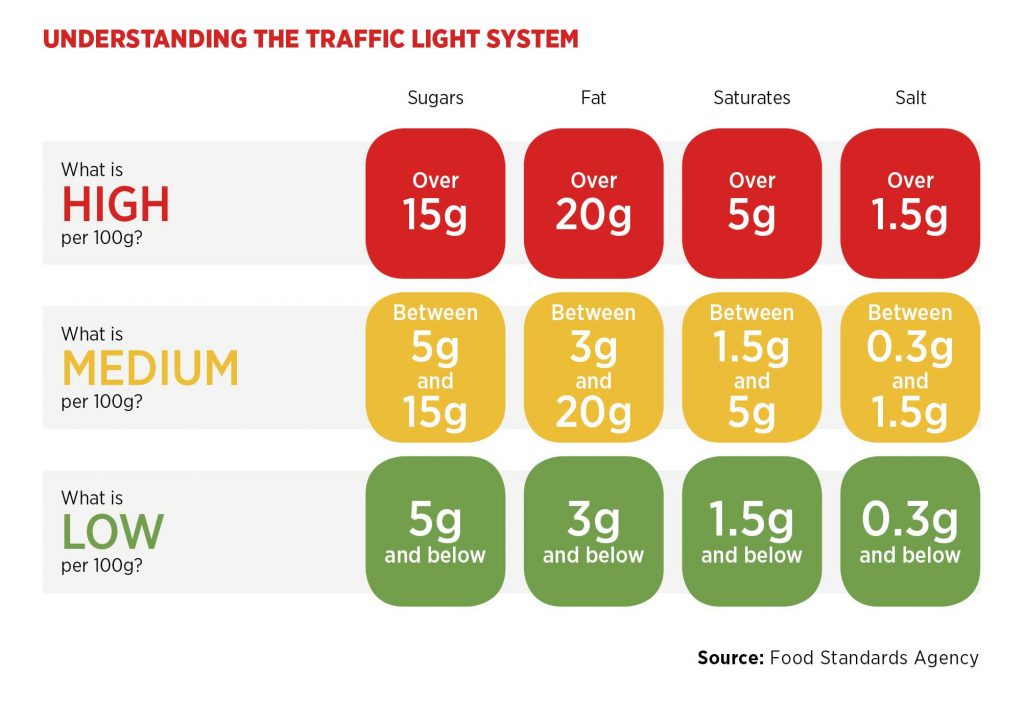
- Traffic Light System – Colours are used to indicate the levels of energy and macro nutrition. As you can see in the picture below High = red, medium = yellow/amber or, low = green.
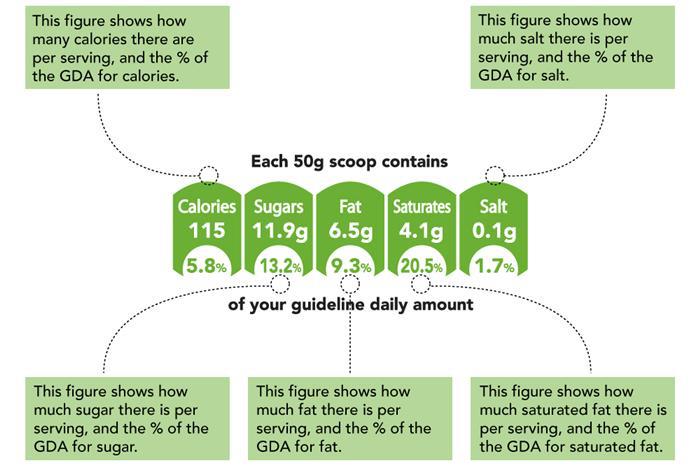
- Guideline Daily Amounts (GDA) – The current Guideline Daily Amounts (GDA) nutrition scoring system is in the process of being replaced by Reference Intake (RI). The GDA is a guide to how much of a certain nutrient you should eat per day, and therefore on packaging, a nutrient is shown as a percentage of the GDA/RI. See picture below.

Problems with Food Labels
There are a number of problems with nutrition labels that need to be highlighted.
- For starters, the GDA is based on average members of the population and their assumed nutritional needs.
What’s average?
The last time I checked, average people didn’t lift or have diabetes.
GDA does not take into account the increased nutrient demands of exercise, muscle mass and high blood glucose levels.
- Certain food manufacturers may deliberately exclude the GDA or Traffic Light System on their product as it could deter consumers from purchasing it.
This is common practice with unhealthy food products like chocolate, desserts and fast food.
- Food manufacturers often trick people into thinking their food has more nutritional value than others by using non-GDA labels such as “High in Omega 3” or, “High in Fibre”, without stating the actual grams or the GDA percentage.
- Use of unregulated health claims like “Reduced Fat” and “Reduced Sugar”.
In order for a food to state the above, it must have 25% less sugar/fat than the standard version of the same food.
- The portion size and associated nutrients are undersized and not reflective of a true portion size.
Food manufacturers rely on consumer behaviour of glancing at the packaging and confirming specific nutritional information like the calorie and fat content.
With this in mind, food manufactures tactfully display the nutritional information of an unrealistic sized portion of the specific food. In other words, letting you see what you want to see.
It’s easy to be fooled and think certain foods like pizza and confectionary are low in calories until you read the small print. Some great examples of tactful food labelling include: 2 squares of this chocolate bar include, ½ of this pizza includes etc.
- Food labels are never 100% exact 1, 2
Don’t think the nutrition labels you read today are an exact representation of the food you are about to eat. Food labels represent average nutritional content.
There are many factors that influence the nutritional composition of individual foods. For example, the time of year it’s grown, the soil, the tree, the diet of the animal, mechanical equipment mixing, ratios of ingredient mix etc.
- Foods containing high amounts of ‘healthy fats’ like omega 3 and certain micronutrients could be coded as red using the Traffic Light System, when in fact they may provide more nutritional benefit than a food coded green – e.g. salmon vs white rice.
Take Home Points
Food labelling is a useful tool to gain basic nutritional information on a food source. The information on the back of the pack can be more informative and less confusing than the front-of-pack labelling.
If you do use food labels to select foods, check the portion size first. If it sounds too good to be true – it probably is.
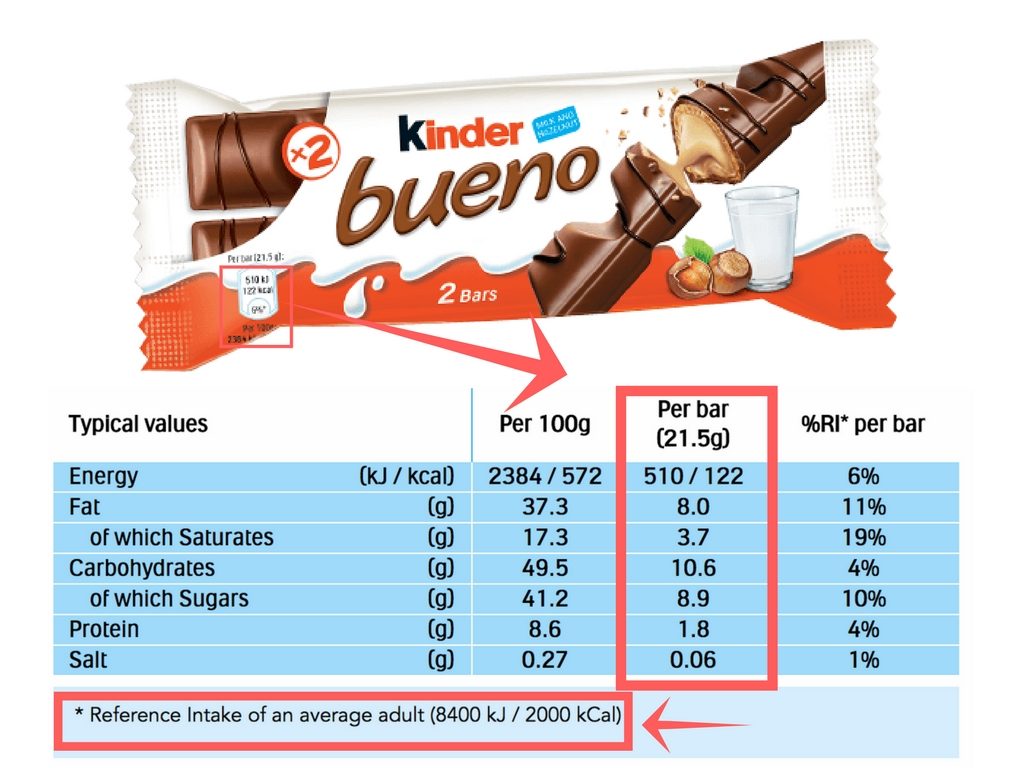
Check out this example of a Kinder Bueno – the nutrition label on the front is for one bar NOT TWO. Information like this is easy to overlook.
Bear in mind that your nutrition needs to be individualized. Relying on GDA is useless, unless you match the exact profile of ‘average’. When building your diet you should consider your level of activity, exercise, muscle mass and diabetes management.
Don’t fall prey to the health claims on the front of food packaging. The rules and legislation surrounding these claims are not strict. Most claims are a play on words, misleading and over exaggerated.
It pays to be educated. Many people misinterpret the nutrition info on a food label, for example, what is the difference between sugars, in the form of fructose, typically found in fruit, vs. straight glucose found in most processed food; or, saturated and unsaturated fat?
Written by Phil Graham
Founder of Diabetic Muscle and Fitness
Sports Nutritionist, Strength Coach, and Fitness Educator
Type 1 Diabetic for 12 years
References
- Jumpertz R et al. Food label accuracy of common snack foods. Obesity (Silver Spring). 2013 Jan;21(1):164-9
- Urban L et al. The accuracy of stated energy contents of reduced-energy, commercially prepared foods. J Am Diet Assoc. 2010 Jan;110(1):116-23.