
How Accurate are Physical Activity Monitors
How Accurate are Physical Activity Monitors
- Manage your Account
- Start Here
- Guides
- Nutrition
- Training
- Lifestyle & Motivation
- Webinars
- Research Reviews
- Resources
What you’re about to get into?
- 870 words – 5 min read.
Key Points
- Activity trackers are a worthwhile investment if you are looking to lose weight.
- They are not 100% accurate.
- There are other important factors besides physical activity that need to be accounted for, including diet, training stimulus, sleep and diabetes management.
FitBit and Apple Watch tend to be the most accurate activity meters out of all those tested
How Accurate Are Activity Trackers?
Walk into any electronics store nowadays and you will find a section dedicated to activity trackers. These advanced little gadgets are available in all shapes, sizes, and colours. Their main function is to track your physical activity levels in the form of steps, distance covered or flights of stairs climbed. Some activity trackers come with extra functions like heart rate, Bluetooth for your phone and even GPS for serious adventurers.
The most constructive use of your activity to monitor is to track your non-exercise activity thermogenesis, commonly known as NEAT.
NEAT represents the amount of physical activity you perform outside of structured exercise.
The reality is most people (including professional athletes) only spend 0.5-1.5 hours in the gym per day. Not all of that is spent training either. This leaves another 22+ hours of activity to be accounted for.
The significance of NEAT is often overlooked in most people’s attempts to lose body fat.
NEAT can influence fat loss in two primary ways:
1. Reduced activity due to reduced energy intake.
Reduced food intake may subconsciously cause an individual to become more self-aware of their energy expenditure and as a result limit movement in an attempt to preserve energy. The same applies to exercise.
‘I haven’t eaten much today’ is often used to justify low energy and performance output.
- Reduced activity due to increased exercise.
This may be explained by feeling tired, exhausted or drained after training. The individual in question may have a tendency to rest or, ‘lie about’ more over the course of the day in an attempt to conserve energy.
Your physical activity levels outside the gym are much more likely to have a greater impact on your fat loss efforts than the time you spend lifting weights in the gym.
Activity Trackers Keep You Accountable
The tendency to move less after exercise or reduced food intake can be compensated by wearing an activity tracker and striving to hit a step count target.
A good example would be walking to the shop instead of taking the car, taking the stairs instead of the lift.
On the other hand, if you have met your step count target there is no need to force yourself to move.
Step counts keep you accountable to a fixed level of activity. This is one of the most important measures, to track alongside calories for fat loss success.
There are many occasions when individuals eat well and follow their exercise regime but still don’t lose weight. This is extremely disheartening and confusing. Provided the individual isn’t cheating on their diet or skipping training – tracking physical activity levels is a major solution.
You’ll move more when monitored.
How Accurate Are Activity Trackers?
An interesting study conducted in 2016 by Chowdhury and colleagues compared the daily energy expenditure estimates from popular multi-sensor activity monitors.
The study involved a group of 30 men and women wearing different activity trackers in free-living conditions.
The data was compared to a criterion method known as Actiheart – a compact, chest-worn monitoring device that records heart rate, Inter-Beat-Interval (IBI), and physical activity.
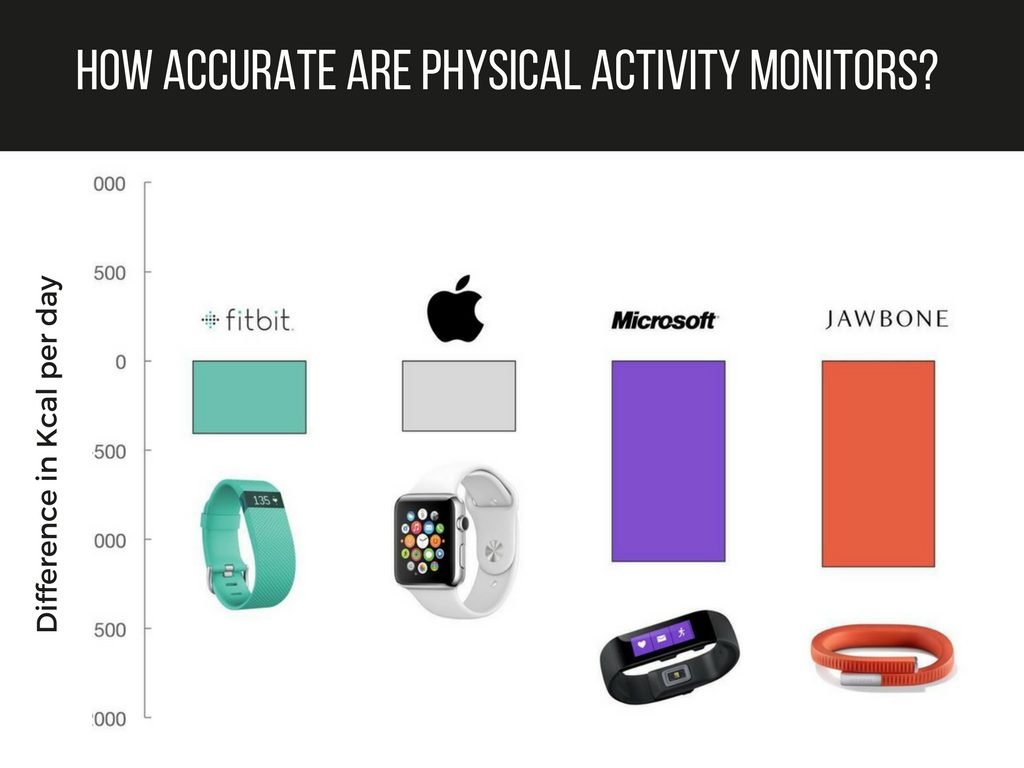
As you can see from the results outlined in the chart above, all four of the mainstream physical activity trackers had a negative bias for mean daily energy expenditure estimates.
In other words, the devices tested underestimated actual daily energy expenditure, with the Apple Watch and the Fitbit Charge HR being the more accurate options, compared to the Microsoft Band and the Jawbone UP24.
The authors concluded that some multi-sensor activity trackers such as the Apple Watch and Fitbit Charge HR provided reasonably good estimates of energy expenditure both in the lab and during free-living conditions. However, not all devices produced similar results.
It was also made clear that devices with more sensors (usually more expensive) do not necessarily produce more accurate energy expenditure estimates than simple previous-generation accelerometer-only devices.
The authors propose that independent quality standards should be developed to verify claims regarding energy expenditure estimation from consumer wearables or manufacturers should be required to provide accuracy ‘ratings’ at the time of going to market.
Other Points to Consider About Activity Monitors
Physical activity monitors may not truly represent the calorie expenditure of individuals who are seriously fit or unfit as the built-in algorithms are based on population norms for Body Mass Index and metabolism. Thus, the closer you are to the healthy average BMI (male and female) the more accurate your activity monitor will be.
The seriously fit are more energy efficient than the average population and more likely to burn off less energy. Whereas the morbidly obese and very unfit tend to be very energy inefficient and may burn off more calories.
It’s also worth noting that activity monitors are more suited to tracking general activity like walking and running as opposed to exercising like lifting weight, swimming and cycling.
Take Home
Physical activity monitors provide a good incentive to monitor physical activity levels outside the gym. The added accountability is definitely worthwhile in an individual’s quest to lose body fat, provided their calories, training regime and blood glucose levels are also in check.
Written by Phil Graham
Founder of Diabetic Muscle and Fitness
Sports Nutritionist, Strength Coach, and Fitness Educator
Type 1 Diabetic for 12 years
References
- Enhad A. Chowdhury et al. 2016. Assessment of laboratory and daily energy expenditure estimates from consumer multi-sensor physical activity monitors. Department for Health, University of Bath, Bath, United Kingdom.
- Access the Paper http://journals.plos.org/plosone/article/file?id=10.1371/journal.pone.0171720&type=printable