
The Truth: Is Sugar Addictive?
The Truth: Is Sugar Addictive?
- Manage your Account
- Start Here
- Guides
- Nutrition
- Training
- Lifestyle & Motivation
- Webinars
- Research Reviews
- Resources
What you’re about to get into?
- 1873 words, 20-minute read.
Key Points
- Blaming today’s obesity problem on sugar is narrow-minded.
- Hyper-palatable foods and food environment are much bigger culprits in the obesity puzzle.
- There is a no compelling evidence to suggest sugar is addictive in humans.
Sugar has got itself a bad reputation and is considered by many to be the main reason for today’s obesity problem. In fact, the notion that sugar is an addictive substance is becoming increasingly popular.
A google search of the words ‘Sugar + addiction’ returns over 10 million results. If you ask the average layperson on the street about sugar, they’ll tell you it’s unhealthy, addictive and will make you fat.
Even the UK government has published draft legislation for a tax on sugar-sweetened drinks, which is set to begin from April 2018. Health campaigners have broadly welcomed the initiative. There will be two bands – one for soft drinks with more than 5g of sugar per 100ml and a higher one for drinks with more than 8g per 100ml.1
Ministers hope it will help tackle the nation’s obesity problem.
Is sugar addiction really the culprit?
Firstly, let’s define the words sugar and addiction.
Sugar is the generic name for sweet, soluble carbohydrates, many of which are used in food.
Addiction is a brain disorder characterized by compulsive engagement in rewarding stimuli, despite adverse consequences. The stimulus can vary from a range of activities including gambling, sex, shopping, drinking alcohol, smoking and food.
The link between sugar addiction and obesity is a growing matter.
As the number of people living with obesity continues to climb, the idea that overconsumption of food is a result of an underlying ‘food addiction’ is becoming gradually more popular.
Understanding Food Addiction.
The term ‘food addiction’ was first used by the physician, allergist, and researcher Theron Randolph from the United States2 to describe the addictive-like consumption of various foods, such as corn, milk, eggs, and potatoes back in 1956. However, the food industry has had massive advances in food technology and product development since this research first evolved; in particular, the increased production of highly processed, hyper-palatable (tasty) junk food, is nowadays considered much more addictive3 that good old-fashioned corn, milk and eggs.
Why research food addiction?
The problems related to obesity have resulted in it being a major public health burden worldwide, in industrialised societies, due to its colossal social and economic impact4. Despite the important developments in the study of obesity, incidence rates continue to rise, suggesting other factors must be involved in the development of this disease.
Health researchers hope that studying obesity under the umbrella of addiction will highlight key areas of focus for prevention, treatment, and public health policy5,6.
Interesting new theories like the food addiction (FA) model have evolved to help explain the widespread advancement of obesity over the last 30 years. The FA suggests that excessive consumption of palatable foods may be understood within the same neurobiological framework as drug addiction.
The FA model has been open to much questioning 7,8 especially the popular view that ‘Sugar is addictive’.
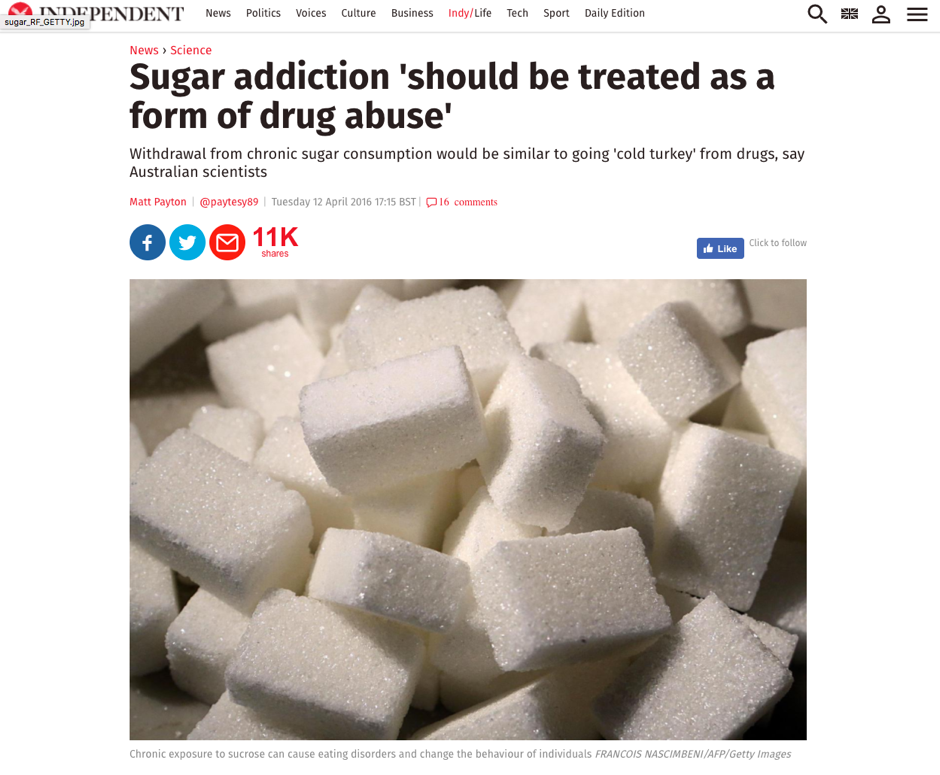
Sugar addiction ‘should be treated as a form of drug abuse’ according to the Independent, another British national newspaper.
Sugar ‘is the new crack cocaine’ according to British national newspaper The Daily Mail.
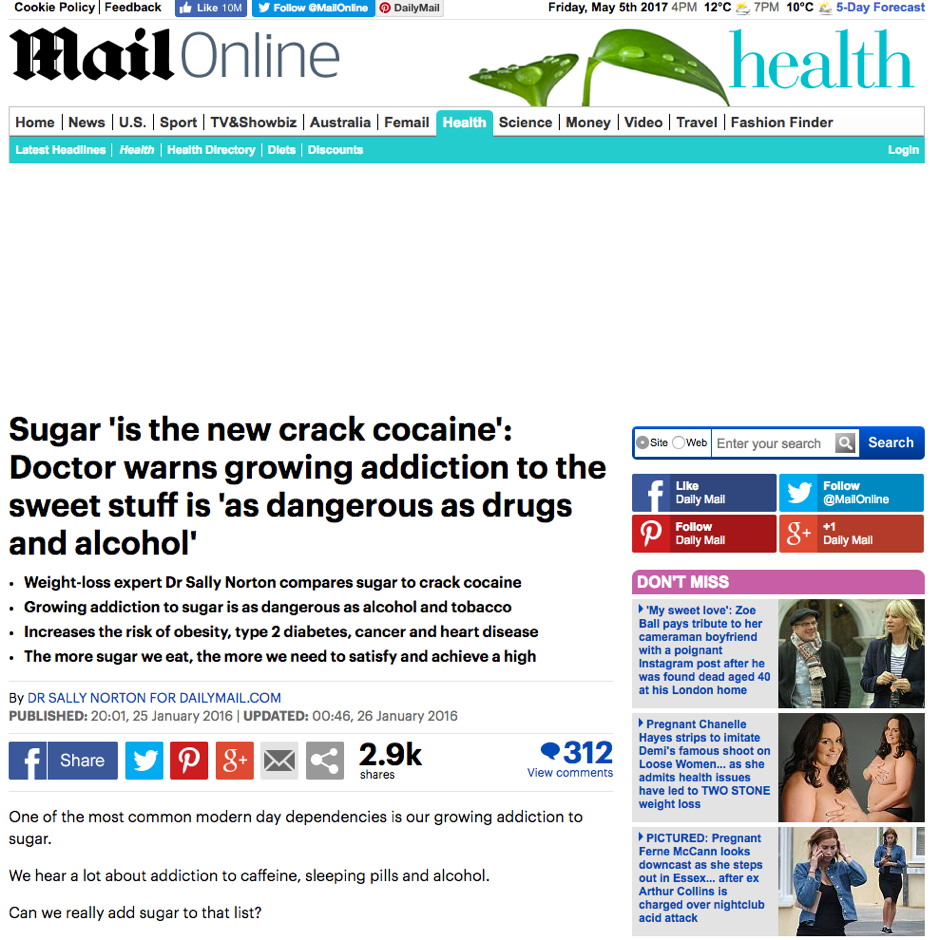
While there is evidence to suggest sugar and sweetness can induce reward centres in the brain (food, in general, does that), it’s hard to take the above claims seriously.
Fortunately, a recent paper by Westwater and colleagues9 published in the European Journal of Nutrition titled ‘Sugar addiction: the state of the science’ sheds some great light on the topic and highlights the evidence for sugar being addictive in humans is far from convincing.
The authors made the following key findings
- The science of sugar addiction at present is not compelling.
- Most of the evidence is limited to the animal neuroscience literature, and it is far from convincing.
- Importantly, several key elements of drug addiction have not been evaluated in sugar addiction models, such as the transition to compulsive drug-taking and dose-dependent effects on addiction liability. There remains a paucity of human evidence in this area, and we did not consider the literature encompassing the behavioural and neural effects of sweet or palatable food consumption as this would be far too indirect to the question of sugar addiction.
- There is limited data on pure sugar consumption as we rarely consume sugar in isolation, and the ecological validity of studies examining pure sugar consumption in humans would be limited.
- Nevertheless, sugar addiction remains a very popular and powerful idea, but as this special issue illustrates, it is by no means alone in this regard when it comes to misconceptions about sugar.
- Even the most perfunctory Internet search reveals how much emotive and explanatory power the term ‘sugar addiction’ has when used in its lay sense for individuals personally, as well as in the context of major public debates such as those over the sugar tax or campaigns such as Action on Sugar in the UK.
- From a health policy perspective, it is unlikely that sugar could be excluded from individuals’ diets given its presence in numerous food items.
- Given the multitude of interacting factors that increase one’s risk for eating disorders and obesity, we argue that support of sugar addiction as a primary causal mechanism of weight gain represents an extremely narrow view that fails to capture the complexity of these conditions, and one that may hamper more coordinated and appropriate responses.
- Furthermore, while there is a pressing need to address these important concerns, we argue that it is dangerous to draw strong conclusions about the validity of sugar addiction based on the current evidence. There are many strong arguments for cutting down the consumption of sugar and reformulating food products accordingly, yet these arguments will all stand or fall according to the scientific case that supports them.
Whilst there’s no real evidence that sugar is addictive in humans, it is fair to say that certain individuals may struggle to control their sugar intake due to food environment, improved availability and access to hyper-palatable, calorie-dense junk food.
Let’s take a closer look at each.
Hyper-palatable junk food
Palatability is the pleasure (i.e. hedonic reward) provided by foods or fluids that is agreeable with our ‘palate’ at a specific time. The palatability of a food or fluid changes relative to the homeostatic satisfaction of our nutritional, water, or energy needs.
The palatability of a food will increase when you are hungry or have an appetite.
Hunger is an experience when your body needs to refuel. Usually, after fasting or physical activity, you’ll get all kinds of symptoms including stomach rumbles, nausea, low blood sugar and weakness.
Once hunger has been fulfilled, the very foods that seemed palatable at the time, become undesirable. This is especially true for whole foods like meat, fish and vegetables.
However, moments later you order a dessert because you fancied something sweet and cold on your tongue.
The latter is known as appetite.
That being, the ‘desire’ to eat.
Even when full, appetite can cause certain individuals to eat.
This is where hyper-palatable junk food can increase obesity risk.
Hyper-palatable foods are designed in such a way that we get increased feelings of pleasure when consuming them. This is achieved by suffusing the foods with increased levels of fat, sugar, flavours, and food additives.
These foods are low in fibre and protein – the two most filling nutrients, meaning they don’t fill you up and are easily overeaten, resulting in a larger food and calorie intakes 10,11.
The end result is increased sugar consumption, higher calorie intake and increased chances of fat gain if the excess energy isn’t burnt off.
Hyper-palatable foods are more to blame for today’s obesity problem than sugar alone. The fact of the matter is: sugar is rarely eaten on its own.
Food Environment
Your environment can have a major influence on what you eat.
If you live in a house that’s full of hyper-palatable junk food, you’re more likely to eat it.
If you get asked out regularly on social occasions, are you at a greater risk of exposing yourself to hyper-palatable food options, and, in order to fit in, you eat what’s given to you.
If you are coping and trying to forget about your problems, there a chance you may reward yourself with hyper-palatable foods because they make you feel better.
If you get a sharing dessert, are you more than likely going to eat more and prevent good food going to waste?
Availability/Access of Hyper-palatable
Junk food is a convenient snack. It doesn’t take much effort to peel back a wrapper and devour. It’s available everywhere you go, even on the road. There’s no escaping it.
Busier lifestyles and less time to cook food from scratch = a greater temptation to grab something on the go in order to ‘fill the gap.
If you lack a basic understanding of how different food sources impact appetite, or how excess calories affect body composition, it’s inevitable you’ll overeat these foods and ramp up the sugar grams.
Take Home – Is Sugar Really Addictive, like everyone says it is?
No, Sugar is not addictive.
It’s unfair and narrow-minded to blame the obesity problem on sugar alone. Generally speaking, as a population we are eating more sugar as a result of improved access and availability to great tasting, highly convenient, calorie-dense junk food.
However, not everyone exposed to hyper-palatable food environments develops obesity.
This gives rise to research that helps identify the biological and/or behavioural motives why people eat highly palatable foods, which could help explain an individual’s susceptibility, or resilience, to obesity. Future research is also required to more extensively study the validity of food addiction in humans.
Written by Phil Graham
Founder of Diabetic Muscle and Fitness
Sports Nutritionist, Strength Coach, and Fitness Educator
Type 1 Diabetic for 12 years
References
- UK pushes ahead with sugar tax http://www.bbc.co.uk/news/health-38212608
- Randolph T (1956) The descriptive features of food addiction; addictive eating and drinking. Q J Stud Alcohol 17:198–224
- Meule A (2015) Back by popular demand: a narrative review on the history of food addiction research. Yale J Biol Med 88:295–302
- Lopez-Legarrea P, Olivares PR, Almonacid-Fierro A, Gomez-Campos R, Cossio-Bolanos M, Garcia-Rubio J. Association between dietary habits and the presence of overweight/obesity in a sample of 21,385 chilean adolescents. Nutr Hosp. 2015;31(5):2088–2094.
- Gearhardt A, Roberts M, Ashe M (2013) If sugar is addictive… what does it mean for the law? J Law Med Ethics 41(Suppl 1):46–49. doi:10.1111/jlme.12038
- Gearhardt AN, Grilo CM, DiLeone RJ et al (2011) Can food be addictive? Public health and policy implications. Addiction 106:1208–1212. doi:10.1111/j.1360-0443.2010.03301.
- Ziauddeen H, Farooqi I, Fletcher P (2012) Obesity and the brain: how convincing is the addiction model? Nat Rev Neurosci 1:279–286.
- Ziauddeen H, Fletcher PC (2013) Is food addiction a valid and useful concept? Obes Rev 14:19–28. doi:10.1111/j.1467-789X.2012.01046.
- Westwater et al. Sugar addiction: the state of the science. Eur J Nutr (2016) 55 (Suppl 2):S55–S69 https://www.ncbi.nlm.nih.gov/pmc/articles/PMC5174153/pdf/394_2016_Article_1229.pdf
- Yeomans MR, Lee MD, Gray RW, French SJ. (2001). Effects of test-meal palatability on compensatory eating following disguised fat and carbohydrate preloads.Int J Obes Relat Metab Disord. 25(8):1215-24. PMID 11477507
- Robinson TM, Gray RW, Yeomans MR, French SJ. (2005).Test-meal palatability alters the effects of intragastric fat but not carbohydrate preloads on intake and rated appetite in healthy volunteers. Physiol Behav. 84(2):193-203. PMID 15708771