
7 Deadly Sleep Sins That Ruin Diabetes Control and Physique Transformation
7 Deadly Sleep Sins That Ruin Diabetes Control and Physique Transformation
- Manage your Account
- Start Here
- Guides
- Nutrition
- Training
- Lifestyle & Motivation
- Webinars
- Research Reviews
- Resources
What you’re about to get into?
2843 words ~20 minutes read
Key Points
- Sleep is a pre-requisite for high-performance living.
- People with diabetes face unique challenges when it comes to sleep.
- Sleep can be broken up into different cycles. Each cycle has a purpose in human health and evolution.
- Poor blood glucose control (highs and lows), Excessive Alcohol, Stimulants, Stress, Poor Sleep environment (your bedroom) and Late night exercise are the biggest culprits for poor quality sleep.
- There are many solutions to help improve the quality of your sleep.
Articles about sleep and health are everywhere. You have read them, right? Get 7-8 hours sleep per night. Everyone knows that, but no article tackles the unique challenges people with Diabetes face, especially if they want to build a better body.
Well, until now!
As you fly through this article you will discover the 7 DEADLY SLEEP SINS that can destroy your blood glucose control, and halt your muscle development. You will be surprised at the innovative strategies that you can employ to get your sleep on track. The strategies will not just help your diabetes control, but they will also help you build a much better body in record time.
Ready to crush the 7 DEADLY SLEEP SINS?
Let’s get stuck in.
Before we get to the sins, I want you to cast your mind back to the last time you got a bad night’s sleep?
- Did you notice you were hungrier than normal?
- Did your training performance suffer?
- Did you struggle to concentrate at work?
- How much more erratic was your blood glucose control?
- Did you need more insulin than normal?
These are common problems I hear every day in my clinical practice as a Diabetes Specialist Dietitian. They also get reported frequently by the people with diabetes we coach for body transformation. Trust me, you are not alone.
Sleep debt is an international epidemic, especially in the western world!
Just so we are on the same page, let’s recap why you need 7-8 hours each night. Large review studies show that if you get more or less than 7-8 hours sleep per night, you are at a greater risk of all-cause death (1). This U-Shaped curve is represented in the top graphs for men (right) and women (left) below. The bottom graphs show the percentage of men and women who get the different hours of sleep.

By virtue of reading this article, my guess is that you are a fairly hard charger, and are more likely to be getting less than 7-8 hours?
Me too. So that’s why it’s important to know the specific negative impact of getting less than 6 hours per night (2,3).
- Increase risk of all-cause death by 12%.
- Increase cardiovascular disease risk by 16%.
- Increase risk of obesity and type 2 diabetes by 38%.
- Increase risk of neurodegenerative disease (e.g. Alzheimer’s).
- Increase risk of depression and anxiety.
Adequate sleep is especially important if you are training hard to get a better body. Two review papers looked specifically at the hormonal changes and recovery from training in people getting adequate sleep vs. short sleep. The research found that if you get adequate sleep, you can expect (4,5):
- Higher testosterone levels.
- In sync Cortisol rhythm.
- Higher Leptin level (fullness hormone).
- Lower Grehlin level (hunger hormone).
- Improved recovery from training.
- A higher level of mood.
- Improved body composition.
You need all of the above to build a great body. So the answer is simple, just get 7-8 hours and you will be cooking on gas, right? Not so fast, sadly sleep debt hits people with diabetes the hardest!
Why?
Because there is a two-way relationship between sleep quality and diabetes control. The relationship can be positive, IF YOU MANAGE YOUR GLUCOSE LEVELS EFFECTIVELY, and employ the unique strategies you will discover in this article.
But most of the time the relationship is TOXIC, with poor sleep leading to erratic glucose levels, and erratic glucose levels leading to poor sleep. The cycle continues, spiralling out of control.
Sound familiar?
Want some proof? Good, I would too. Two recent review papers compared the sleep of people with and without diabetes (6,7):
- Children with diabetes sleep 26 minutes less per night.
- Adults with diabetes have lower sleep quality scores. They do not get as deep sleep, and have a shorter “Anabolic window”.
- Adults with diabetes have a 39% increased risk of Obstructive Sleep Apnoea (OSA), a condition where you intermittently stop breathing in your sleep. This is a crippling condition that impacts overall health if not managed effectively.
One study investigating a group of seven people with diabetes found that one night of sleep deprivation increased insulin resistance by 20% (8). I can attest to this from very recent experience.
“I have Type 1 Diabetes and recently became the very proud father of a little girl, Grace. Along with the elation came chronic sleep deprivation. I dropped from my usual 7-8 hours per night to 4-6 hours, depending on Grace’s kindness. My total daily insulin dose increased by 30%. This is something I have seen frequently in clinical practice.”
What is sleep architecture, and how does erratic blood glucose control change it?
Going into the different stages, hormonal changes, and the physical and mental rejuvenation of sleep is beyond the scope of this article. Head over to the Diabetic Muscle and Fitness Training Lab and check out The Definitive Guide to Sleeping Better for Health, Strength and a Better Looking Physique.
The Definitive Guide to Sleeping Better for Health, Strength and a Better Looking Physique.
The diagram below gives you the basics. It shows a good night’s sleep should have five ninety minute cycles. The first three cycles are mainly spent in deep sleep, where physical restoration happens, often called the “Anabolic window”. This is where you develop your GAINZ! The last two cycles are spent mainly in Rapid Eye Movement (REM) sleep. This is where you commit your daily experiences into long-term memory, hence the “Learning window”.
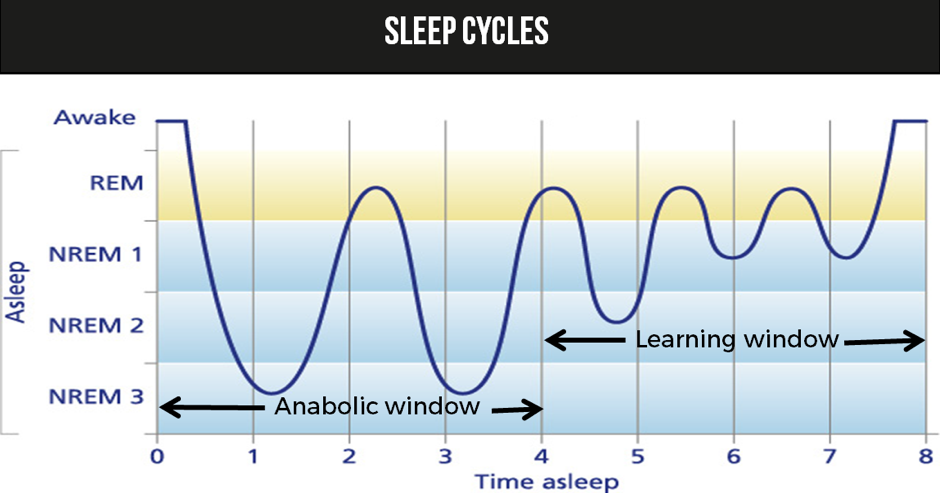
If your glucose level drops low during the night, the stress hormones released stop you from enjoying the deepest stages of sleep. This means you get a very narrow “Anabolic window”, and your muscle building is compromised. If your glucose level runs high through the night, you spend less time in the “Learning window”, and your mental development is affected (6).
Quite simply:
TO GET FULL PHYSICAL AND MENTAL RESTORATION, YOU NEED A STABLE GLUCOSE LEVEL THROUGHOUT THE NIGHT.
The 7 DEADLY SLEEP SINS
First, let’s see how many you are committing:
- Lights:
Do you look at your SMART phone, tablet or play on the computer after 20:00?
Do you have normal light bulbs with no dimmer switch in your bedroom, sitting room, and bathroom?
Do you get exposure to daylight in the first 30 minutes of your day?
- Do you drink caffeine after 15:00?
- Do you drink alcohol more than one night a week?
- Do you exercise after 19:00?
- Do you stay up late at the weekend?
- Is your bedroom temperature above 20C or 68F?
- Do you eat and give insulin within two hours of going to bed?
1. Bathing in BLUE LIGHT.
Very simply, the human body has evolved waking up with the sun and going to bed with the moon. We have a special area in the brain called the Suprachiasmatic Nucleus (SCN) that detects light, and sets your body clocks accordingly.
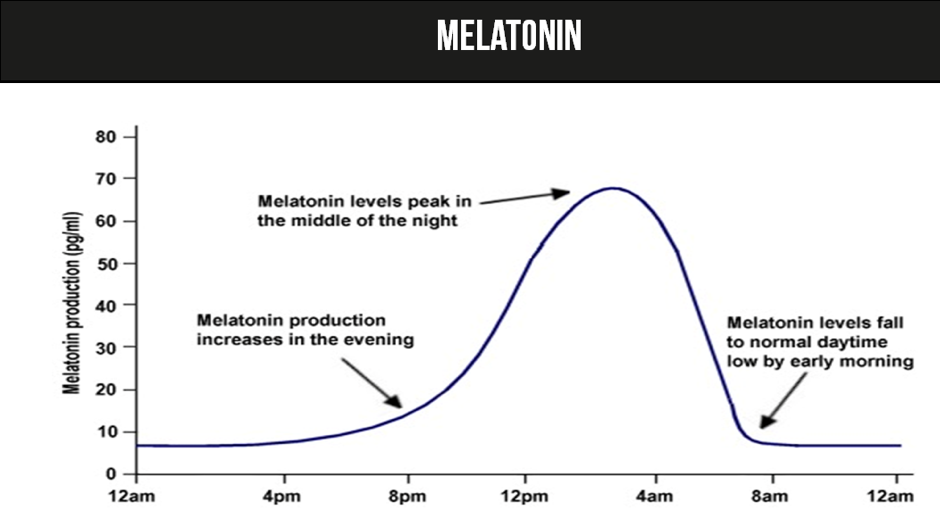
This worked perfectly until we invented the light bulb, SMART phones, computers and le discotheque! The blue light emitted from artificial light massively disrupts the natural rhythm (Circadian rhythm) of our body. The main impact is at night, specifically after 20:00 when the body should be producing Melatonin, the sleep hormone. The natural Melatonin rhythm is shown below.
The blue light beamed into our eyes from these devices stops the production of Melatonin and stops us from sleeping. You can see this clearly from the below study on 11 people who were exposed to blue light all night (white circles) (9). Interestingly when the light was dimmed (black squares), or they put on blue light blocking glasses (white triangles), Melatonin was not affected.
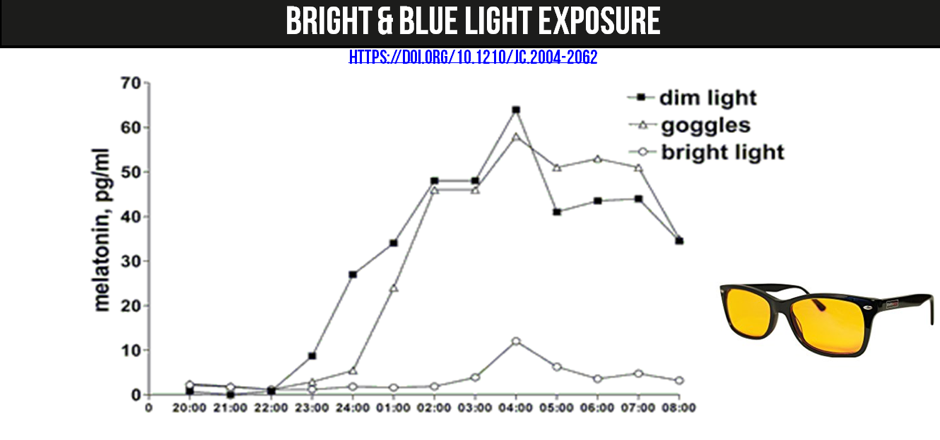
If you are with me so far you understand BLUE LIGHT AT NIGHT IS BAD. Not to worry, the solutions are simple:
- Get dimmer switches in your front room, bedroom and bathroom.
- Turn off all SMART devices, tablets and computers by 20:00.
- If you cannot because of work or you are addicted to social media, you need to block the blue light:
- F.lux for your computer screen.
- Use NIGHTSHIFT on the iPhone
- If you cannot because of work or you are addicted to social media, you need to block the blue light:
- Blue light blocking protective sheet for other phones and computer screens.
- Buy a pair of sexy blue light blocking glasses. I have a pair, they are definitely indoor wear!
- Get exposure to natural light within the first 30 minutes of waking up, this will jump start your daytime circadian rhythm.
- Invest in a high-quality sleep mask or blackout blinds to block blue light pollution from outside. Great for when you are travelling or staying in hotels.
2. Late caffeine intake.
Why does caffeine make you feel awake?
Simple. Caffeine blocks a hormone called Adenosine from hitting the sleepy receptors in your brain, so BING, you feel awake!
This is the buzz you desire in the morning, but not as you try to get to sleep. Have you ever fallen foul of drinking an espresso at the end of a meal? Did you stare at the ceiling all night?
Once consumed, caffeine hangs around in your system for the next 5-8 hours, depending on your tolerance and sensitivity. Are you someone who is wired by one cup of coffee, or do you need two or three cups to feel it?
The simple solution is to have your last caffeine-containing drink by 12:00 – 15:00, depending on your tolerance. Hold off these drinks after your caffeine curfew.
- Coffee or tea.
- Red bull or stimulant drinks.
- Pre-workout loaded with Caffeine and similar substances such as Guarana.
- Diet Coke or Dr Pepper.
The caffeine story has a lot more to it, much more than can be covered here. But to give you an insight:
- You should aim to keep your daily intake to no more than 400mg/day.
- For an exercise boost you need 2-3mg/kg or 1-2mg/lb. Be sure to deduct this from your daily allowance.
- Tolerance can build very quickly and you need to keep an eye on your intake to prevent dependency.
For more detailed information hop over to the Diabetic Muscle and Fitness Training Lab and check out The Definitive Guide to Sleeping Better for Health, Strength and a Better Looking Physique.
3. Frequent alcohol consumption.
Most western people enjoy an alcoholic drink every now and then. There is nothing wrong with that. Like with any drug, the danger is in the dose and frequency. Especially when it comes to alcohol and Diabetes.
The below picture shows how alcohol changes sleep architecture. Very simply:
- The first four hours is much deeper. This presents a unique danger for people with diabetes, as they do not awake with their usual signs of hypoglycaemia. Remember that alcohol also stops the liver putting out glucose, so there is a double whammy.
- In the second four hours, there is a rebound effect, where REM is missed. That’s why if you have too many alcoholic drinks, YOU CANNOT REMEMBER A THING!
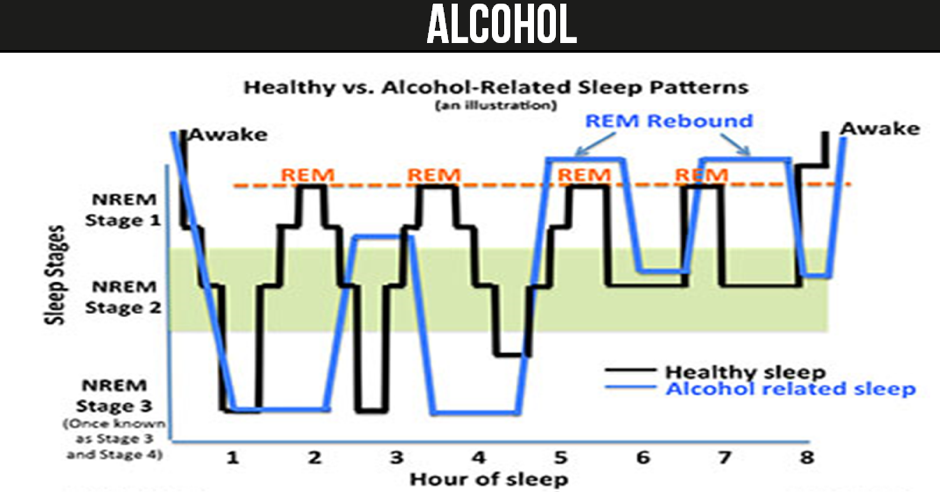
If you are someone who drinks alcohol more than once a week, you are almost certainly putting yourself in sleep debt. This will make building a better body a very slow process and will put you at a greater risk of nasty nighttime hypos.
Simple solutions:
- Keep control of your drinking frequency. If you are training hard to develop your physique, drink alcohol no more than once a month.
- When drinking, take hypoglycaemia precautions such as reducing your background insulin before bed or having a small carbohydrate snack.
4. Late night exercise.
Regular exercise is great for getting a sound night’s sleep. In particular, early morning activity jump starts your daytime circadian rhythm (10). However, if you are doing intense workouts past 19:00, you are probably causing sleep issues. Have you ever been kept up by your body buzzing after a late workout?
Late night intense exercise increases stress hormones and your body temperature, just when they should be dialling down. It is the same effect of having a double espresso right before bed.
Simple solutions:
- Do some light activity in the morning whilst getting natural light exposure. A 10-15 minute walk or mobility routine is perfect.
- Get your workouts completed by 19:00.
5. Burning the candle at both ends.
Do you live like a monk during the week, but at the weekend you are up late watching Netflix or partying hard? If so, you will be experiencing a phenomenon called “Social Jetlag”.
This means at the weekend you are throwing your body’s circadian rhythm out of sync. When it comes to Sunday night you thrash around in bed trying to get to sleep. You wake to feel exhausted, and this can last until Wednesday, especially if you hit the booze at the weekend.
If the only issue was tiredness, that would be ok, but it’s not. Social jetlag reduces both your “Anabolic window” and your “learning window”.
If you are serious about building a strong physique, you need to tackle this issue.
Solutions:
- Have a fixed bedtime and waking time for every day, not just the weekdays. Getting to sleep by 22:00 and waking at 06:00 would be perfect. But you could go an hour or two either way, as long as it’s consistent.
- If you are going to do a Netflix bender, do it during the day.
6. Sleeping in a sauna (your bedroom)
The human body evolved going to sleep with the moon. As the moon rises, the temperature drops. This cooling is a signal to the body to increase melatonin production. This is displayed nicely in the picture below.
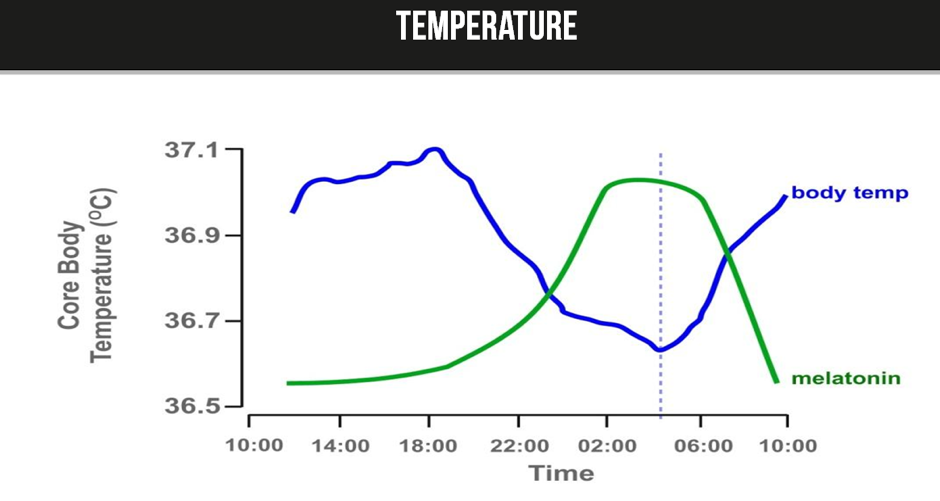
Your house, especially your bedroom, should be at 15-20 degrees Celsius, or 60-68 degrees Fahrenheit. I can almost guarantee your bedroom temperature will be much higher than this, especially if you have a heat-loving partner! If so, your sleep quality is being disrupted.
Solutions:
- Get a cheap thermostat for the bedroom.
- Make sure you have a summer quilt with a low TOG (1-3), and a winter quilt with a little higher TOG (6-10).
7. Going to bed with an unstable blood glucose level.
We have already mentioned that erratic glucose levels impact sleep. Two points from the research are worth re-iterating (6):
- If your glucose level drops low during the night, the stress hormones released stop you enjoying the deepest stages of sleep. This means you get a very narrow “Anabolic window”, and your muscle building is compromised.
- If your glucose level runs high through the night, you spend less time in the “Learning window”, and your mental development is affected.
Going to bed with a stable glucose level is of paramount importance. Some strategies that will help you do this are:
- Last meal and insulin dose three hours before bed.
When you do your last check, there will be little insulin still working from the previous dose. This means the glucose level should stay fairly stable throughout the night. If you need to correct a high level, you should be able to do it confidently.
- If you have exercised hard, you may be at risk of dropping low during the night. You could reduce your background insulin by 20%, or have 20g of protein to steady the glucose level through the night.
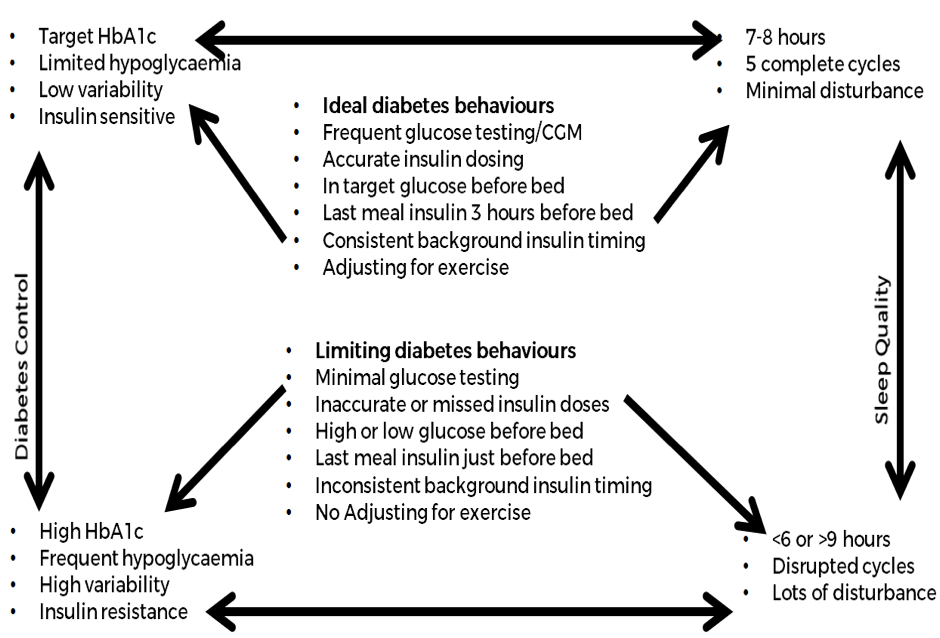
There are a lot more strategies you could try which are detailed in the Training Lab. The below graphic shows the complex relationship between diabetes and sleep, and the diabetes behaviours that will ensure the relationship is a positive one.
Summary
By now you realise the value of sleep and how the modern environment is working against us. You understand that having diabetes poses difficulties, especially if you have unstable glucose levels overnight.
You have no doubt identified which of the 7 DEADLY SLEEP SINS are causing issues for your diabetes control, and slowing your physique improvements; more importantly, you now have a raft of solutions to fix this!
This article only covers 30% of the information, practical strategies and personal insights available in the Training Lab. There are other key areas you need to consider when trying to optimise sleep:
- Nutrition and the impact of the microbiome.
- Stress and the most effective mindfulness techniques.
- And much more.
If this article has stimulated your appetite, you MUST head over to the Diabetic Muscle and Fitness Training Lab and check out The Definitive Guide to Sleeping Better for Health, Strength and a Better Looking Physique.
See you in the lab.
John Pemberton
Type 1 Diabetes (2008)
Registered Dietitian
Head Coach at Diabetic Muscle and Fitness
References
- Arch Gen Psychiatry.2002 Feb;59(2):131-6
- Sleep Med. 2017 Apr;32:246-256;
- Ann Intern Med. 2010 Oct 5; 153(7): 435–441.
- Med Hypotheses.2011 Aug;77(2):220-2.;
- Neuropsychiatr Dis Treat. 2007 Oct; 3(5): 553–567
- Sleep Med.2016 Jul;23:26-45
- Diabetes Spectr. 2016 Feb; 29(1): 10–13.
- Diabetes Care. 2010 Jul; 33(7): 1573–1577.
- https://doi.org/10.1210/jc.2004-2062
- https://www.hindawi.com/journals/apm/2017/1364387/